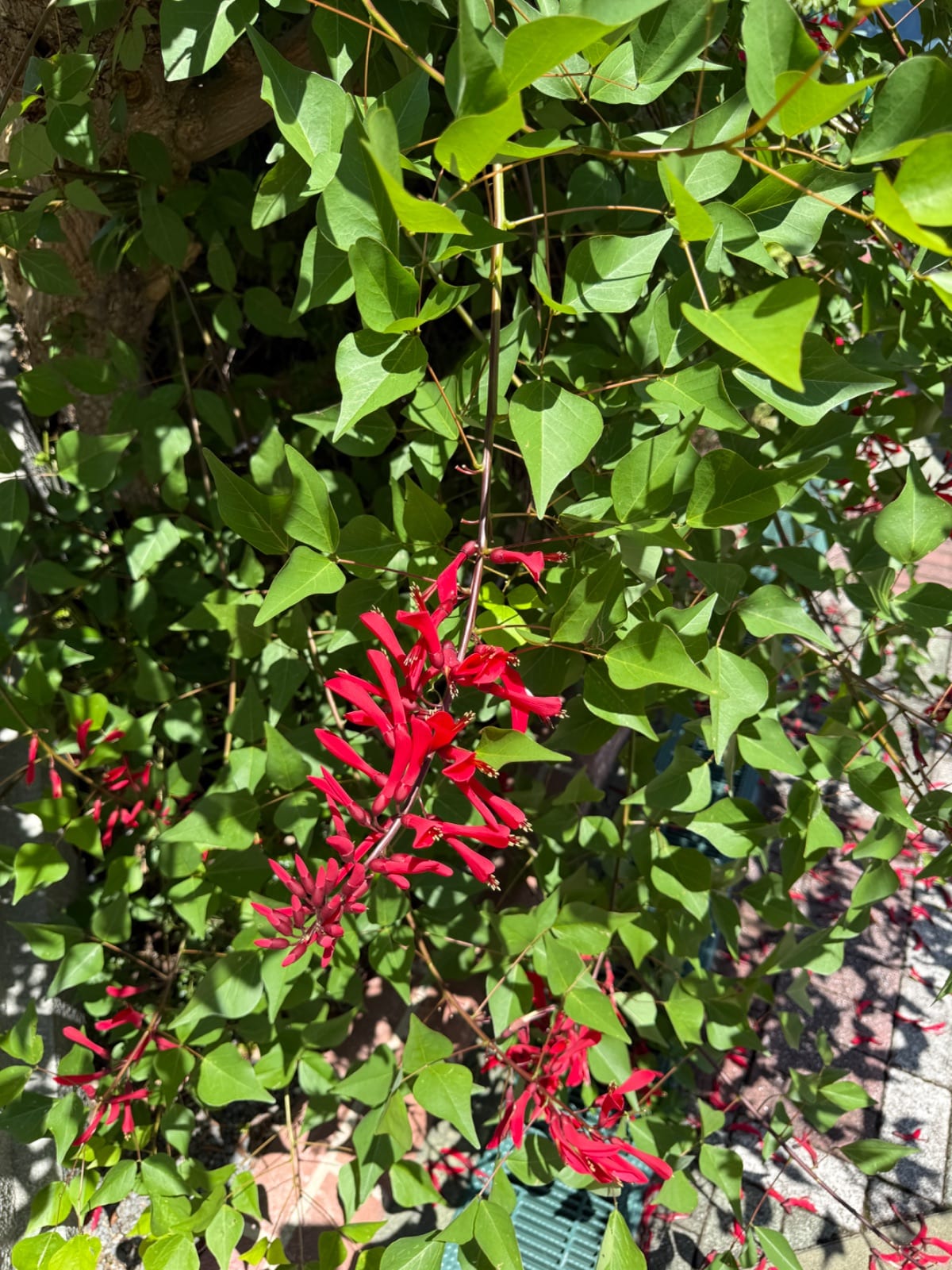
Firecracker plant (Russelia equisetiformis; synonym R. equisetifolia)
설명
The plant in your photo appears to be the Firecracker plant, Russelia equisetiformis (often grown outdoors in warm climates and used in landscapes and containers). It’s recognizable by its upright, many-branched stems and clusters of slender, tubular bright-red flowers that resemble small fireworks. The foliage is made up of relatively small, bright-to-medium green leaves that look somewhat narrow/linear from a distance, though in this species the leaves are typically small and not as scale-like as in some other Russelia. In full sun, the plant produces lots of vivid red blooms that stand out strongly against the green foliage. It also tends to form a bushy thicket with arching stems, and the flowering is continuous or at least long-lasting during warm seasons. ### Key characteristics - **Growth habit:** An upright-to-arching, branching shrub/subshrub that can become bushy. In the landscape it often looks like a “lace” of stems with flowers emerging along the tips and sometimes along the sides. - **Flowers:** Bright red, tubular blossoms, produced in clusters. Each flower typically looks like a thin firecracker or small trumpet, with a flared opening. - **Leaves:** Small green leaves on slender stems; overall foliage looks airy rather than thick and leathery. - **Bloom season:** Mostly spring through autumn in many climates; flowering can be prolific during hot weather. - **Attracts wildlife:** The flowers commonly attract hummingbirds and pollinating insects. ### Where it grows best Firecracker plant is usually happiest in **warm conditions**. It tolerates a range of soils but generally prefers well-draining conditions. In cooler climates it may be grown as a patio plant or brought indoors (though it can be challenging indoors due to light demands and airflow). - **USDA/temperature note (general):** It is commonly treated as **tender**; it can be damaged by frost and may die back or be killed when temperatures drop significantly. - **Sun exposure:** Full sun is strongly preferred for best flowering. Partial shade can be used but bloom intensity often decreases. ### Light care - **Best:** 6–8+ hours of direct sun. More sun typically means more flowers and sturdier growth. - **Too little light:** Stems may become leggy, foliage may thin, and flowering will reduce. ### Watering routine Firecracker plant generally likes regular watering while establishing, then slightly drier conditions once established. - **New plants:** Water thoroughly after planting, then keep the root zone evenly moist (not soggy) for the first weeks to months. - **Established plants:** Water when the top few centimeters of soil dry out. In hot weather, this may mean weekly watering; in cooler or rainy periods, less. - **Avoid waterlogging:** Good drainage is essential. Prolonged wet soil can lead to root problems. - **In containers:** Check more frequently—pots dry faster. Water thoroughly until water drains out the bottom, and empty saucers. ### Soil and drainage - **Ideal soil:** Well-draining garden soil or cactus/potting mix. A mix with added perlite/pumice or coarse sand works well. - **pH:** Usually not very fussy; a neutral to slightly acidic/alkaline range is typically fine as long as drainage is good. ### Fertilizer (to encourage more blooms) To support flowering: - **In-ground:** Apply a balanced fertilizer (or a bloom-focused fertilizer) during the active growth season. - **Container plants:** Use a diluted liquid fertilizer every 3–4 weeks during spring/summer. - **Avoid overfeeding nitrogen:** Too much nitrogen can boost leaf/stem growth at the expense of blooms. ### Pruning and shaping Pruning is helpful for maintaining a compact, attractive form. - **When to prune:** Light pruning can be done after major flushes of bloom, and a more noticeable shaping can be done in late winter/early spring (in frost-free regions) or after the cold season. - **How to prune:** You can cut back leggy stems and remove spent blooms. This often encourages branching and fresh flowering tips. - **Hard pruning:** The plant generally responds well to rejuvenation pruning, but avoid extreme cuts if it’s actively in heat stress. ### Propagation Firecracker plant is commonly propagated by: - **Softwood or semi-hardwood cuttings** in warm weather. - **Stem cuttings** placed in a well-draining medium and kept lightly moist until rooting. Seed propagation exists but cuttings are usually faster for reliable results. ### Common pests and problems In general, Russelia is fairly hardy, but keep an eye out for: - **Aphids and scale/insects:** Can cluster on tender new growth. - **Spider mites (especially indoors or in hot, dry conditions):** Fine webbing or stippling on leaves. - **Root rot:** Typically caused by poor drainage and overwatering. - **Leaf drop / weak growth:** Often linked to insufficient sun, cold stress, or inconsistent watering. **Prevention tips:** Provide good airflow, avoid chronically wet soil, and keep plants in as much sun as possible. ### Winter care (climate dependent) - **Mild winters (no frost):** Keep watering minimal but don’t let it fully dry out. - **Frost-prone areas:** Bring container plants indoors before cold temperatures. For in-ground plants, consider protection (mulch/cover) and understand that frost can damage above-ground growth. - **Indoor overwintering:** Give the brightest window possible, reduce watering, and avoid drafts. Indoor flowering may be limited. ### Related information and companion planting Firecracker plant works well in: - **Borders and mixed shrub plantings** where the airy, bright-red flowers can be a focal point. - **Pollinator gardens** because of its nectar-rich blooms. - **Drought-tolerant or low-water landscaping** *once established* (though it still needs some water during establishment). It pairs nicely with plants that enjoy similar light and drainage—such as lantana, salvia, ornamental grasses, or other warm-season flowering shrubs. ### Important note about identification Several ornamental shrubs can have red tubular flowers and similar “firecracker-like” blooms, so photo-based identification can be uncertain. Your plant strongly matches **Russelia (Firecracker plant)** due to the red tubular flower clusters and overall growth pattern, but leaf shape and exact species can vary. If you want a more certain ID, share a close-up photo of a single flower (showing the tube/opening), and a clear view of the leaf arrangement and stem form.
식별 시간
2026년 6월 10일
안내
식집사의 기능은 AI를 사용하고 있어 부정확 할 수 있습니다. 단순 재미와 참고용으로만 사용해주세요.
식물 결과에서 바로 할 수 있는 일
이름을 확인한 뒤 공식 식물 DB에서 관리 정보를 바로 확인하세요.