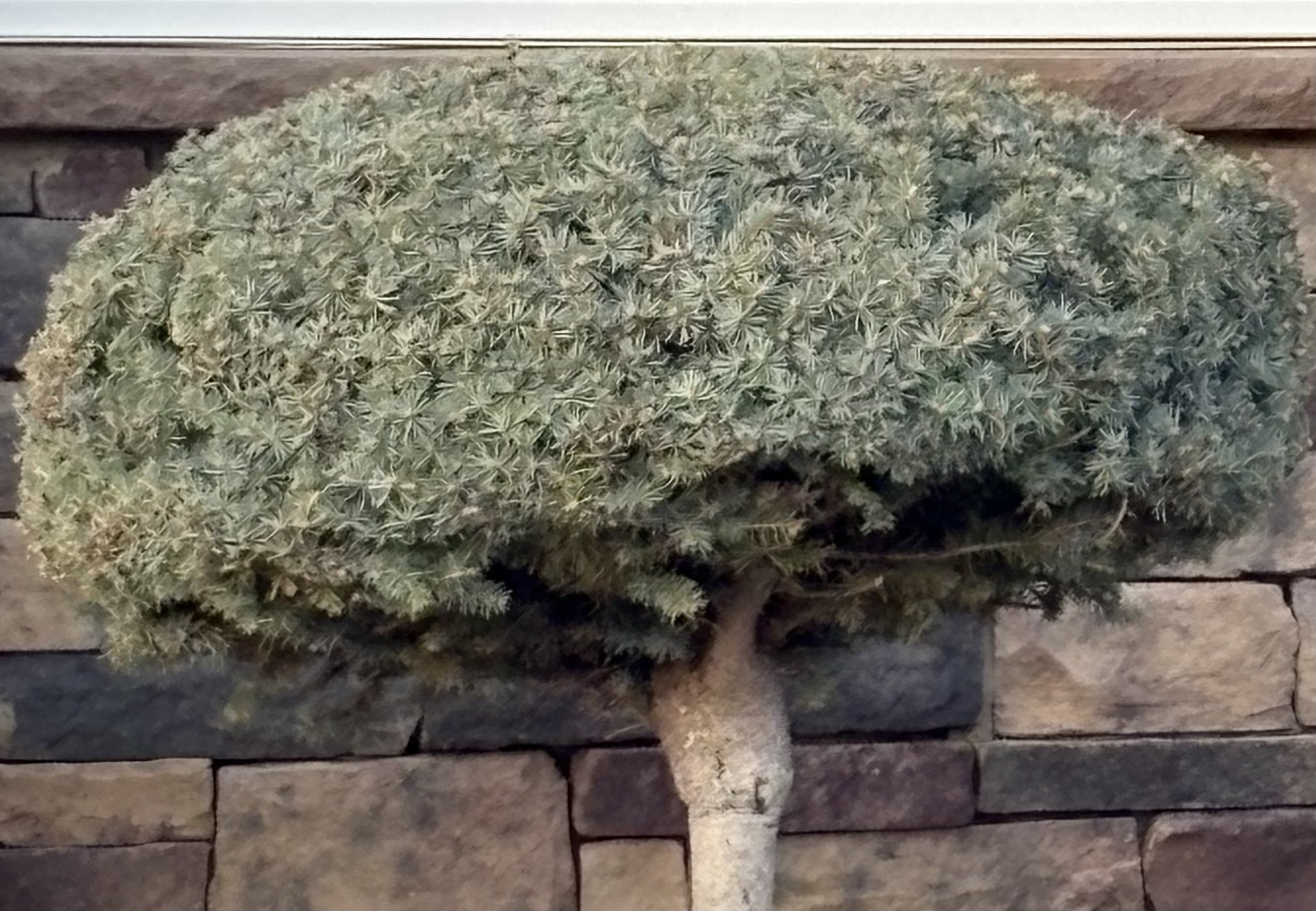
Dwarf Juniper topiary (likely Juniperus sp.)
설명
The plant in the photo appears to be a dwarf juniper trained as a small tree, with a single light-gray trunk and a broad, rounded crown densely packed with bluish-green, needle- or scale-like foliage. The leafy mass is very full and even, giving the plant a mushroom-like umbrella shape that is commonly seen in ornamental junipers used as focal points in gardens. Junipers (Juniperus) are evergreen conifers in which foliage can be either slender needles or flattened scales; many garden cultivars display a dense, compact growth habit with a bluish or gray-green color when mature. The plant in the image shows juvenile foliage (which may be more needle-like or star-shaped in close view) that remains attractive throughout the year, resisting leaf drop in winter. The trunk is relatively smooth, pale gray to tan, with a rougher bark near the base; the canopy sits high enough above the trunk to create a clear silhouette typical of a standard or clump-style topiary. The overall size in the photo suggests a small landscape specimen rather than a large tree, though junipers can be long-lived and gradually increase in height if allowed to grow. Distinctive features to help identify junipers include the evergreen, evergreen-like texture, the fan- or ribbon-like branch arrangement, and the bluish-green color of the foliage, which often carries a slight waxy bloom that gives the plant a frosted appearance. The plant’s most appealing aesthetic is its uniform, cushiony dome that remains intact through seasons, provided it is kept free of overgrowth and dehydration. From a horticultural perspective, this form is highly valued for creating a focal point in mixed borders, lining driveways, or serving as a low screen. The plant's care requirements reflect its tolerance for sun and drought and its preference for well-drained soil. When growing conditions are favorable, junipers are moderately fast-growing, though the exact rate depends on cultivar, climate, and pruning. For this reason, consistent, light shaping is often preferred to let new growth appear in a controlled manner rather than heavy, abrupt trimming that can stress the plant. In terms of potential variability, note that junipers vary widely in leaf texture (needle-like versus scale-like) and growth habit. In hot, dry climates, blue-green junipers like the pictured plant may hold color more vividly and resist drought better than greener cultivars; in cooler or damper environments, provide protection if late-spring frosts are common. Overall, the plant is a robust, hardy evergreen that tolerates pruning into formal shapes and can function as a sculptural element in landscape design. Care and cultivation: Light and site: Junipers crave full sun—ideally at least six hours of direct sunlight each day—for best color, density, and branching. In shade, growth slows, foliage often becomes thinner, and the color may dull. Soil and drainage: They prefer well-drained soils; they do not tolerate heavy, waterlogged conditions, which can lead to root rot. A sandy loam with moderate organic matter is ideal; in clay soils, improve drainage with raised beds or by amending the soil with organic matter and coarse sand. Watering: Established junipers are relatively drought-tolerant; they should be watered deeply but infrequently rather than with light, frequent irrigation. In hot, windy, or dry periods, water more thoroughly, allowing the top several inches of soil to dry out between waterings. New plantings require more frequent moisture until the root system becomes established, typically during the first growing season. Mulching: A 2–3 inch layer of organic mulch around the base helps retain soil moisture, regulates temperature, and suppresses weeds; keep mulch a couple of inches away from the trunk to avoid rot. Fertilization: Apply a light, balanced fertilizer (for example, a slow-release product with equal or slightly higher phosphorus and potassium than nitrogen) in early spring. Avoid high-nitrogen fertilizers, which can push excessive soft growth that is more susceptible to pests and winter burn. Pruning and shape: Junipers tolerate pruning well and are commonly shaped into spheres, cushions, or standards. For a dome-shaped topiary, selectively remove growth along the outer edges to maintain a symmetrical silhouette, using clean, sharp tools to avoid ragged cuts. The best time to prune is in late winter to early spring before new growth begins (or after new growth in late summer in some climates). Do not cut into the hard wood of older branches, as junipers can respond poorly to severe cuts. Watering after pruning helps the plant recover; avoid heavy pruning in extreme heat or drought. If the crown becomes too sparse or uneven, light, selective thinning can refresh vigor and improve air circulation; remove dead or diseased shoots promptly. Disease and pests: Junipers are relatively pest-resistant but can be affected by scale insects, spider mites, and in some climates by juniper blight or gummosis if conditions are overly damp or crowded. Good air circulation, avoiding overhead watering, and proper spacing help reduce disease risk. Regular inspection helps catch pests early; horticultural oils or systemic insecticides can be used if infestations are severe, following label directions. Propagation: Junipers are commonly propagated by cuttings or layering, though rooted cuttings can take time to establish, especially in cooler climates. For cuttings, use semi-hardwood material in late summer, remove lower leaves, dip in rooting hormone, and keep in a warm, humid environment until roots form. Pests and problems: Typical symptoms of stress include browning tips along the canopy, thinning of the interior growth, or yellowing foliage. These may indicate too much sun exposure in a sensitive cultivar, drought stress, or poor drainage leading to root problems. In heavy soils or overly wet climates, ensure proper drainage; prune away dead branches, and adjust watering and fertilization accordingly. Longevity and maintenance: Junipers can live for decades and even centuries in favorable conditions. The bonsai-like stem in your image suggests patience in shaping, as the trunk forms slowly and the crown expands gradually with careful pruning. If you want to maintain a compact, topiary-like form, schedule annual pruning sessions in late winter or early spring; if you prefer a looser natural look, prune only to remove dead wood and to maintain balance as the plant grows. Landscape uses: This form is popular as a specimen plant, a focal point in a rock garden, or a stand-alone accent near doors or entryways. It can be combined with low-growing groundcovers to emphasize contrast in texture and color. In terms of indoor use, junipers generally perform best outdoors; if used indoors, ensure bright light, good ventilation, and avoid overly dry indoor air. Some small cultivars can be grown in bright, cool rooms or sunrooms, but be mindful that indoor conditions may not closely mimic the plant’s native environment, potentially causing slower growth, pale color, or stress. Summary: The plant pictured appears to be a dwarf juniper topiary, a hardy evergreen conifer known for its dense, bluish-green foliage and a rounded crown atop a stout trunk. It is well-suited to sun-drenched landscapes with well-drained soil and benefits from light, regular pruning to keep its dome shape. Its drought tolerance, low maintenance, and sculptural silhouette make it a favorite for modern landscape design, where it can serve as a sculptural focal point, accent plant, or topiary specimen. With proper care—sufficient sun, drainage, judicious pruning, and occasional feeding—this plant will reward years of year-round color and structure.
식별 시간
2026년 4월 4일
안내
식집사의 기능은 AI를 사용하고 있어 부정확 할 수 있습니다. 단순 재미와 참고용으로만 사용해주세요.
식물 결과에서 바로 할 수 있는 일
이름을 확인한 뒤 공식 식물 DB에서 관리 정보를 바로 확인하세요.