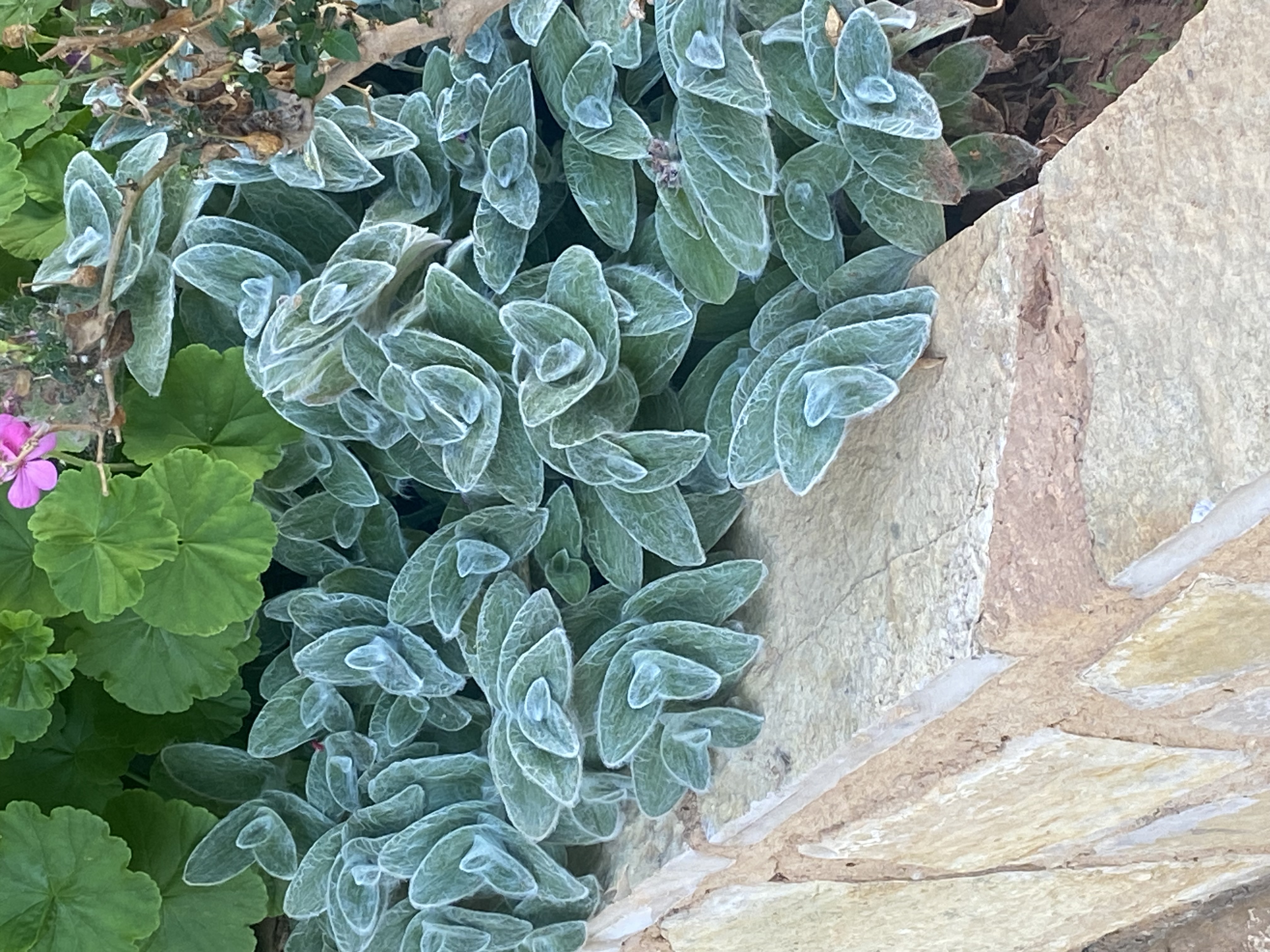
Stachys byzantina ‘Silver Carpet’ (Lamb’s Ear)
설명
The plant in your photo strongly resembles Lamb’s Ear (Stachys byzantina), especially the dense, rosette-forming, spoon/teardrop-shaped leaves with a silvery-blue, felted (hairy) look and a scalloped/wavy margin. However, a few details—such as the exact leaf size and how the plants are arranged—can overlap with other Stachys cultivars (and occasionally with similarly textured ornamentals). Because the overall “signature” (fuzzy silver foliage in tight clusters) is very characteristic of Stachys byzantina cultivars, I’m identifying it as that group, likely a low, spreading variety such as ‘Silver Carpet’. ## Characteristics (what you’re seeing) Lamb’s Ear is a perennial in the mint family (Lamiaceae) grown primarily for its foliage. It forms low, mounded clumps of heavily hairy leaves. The hairs give the leaves a soft, velvety texture and create the distinctive grey-silver color. In many cultivars, the leaves look almost “whitewashed” or bluish-silver under sunlight, and they can show gentle ripples along the edges. From the center of the clumps (typically in late spring to summer), it sends up upright flower spikes on slender stems. The flowers are usually small and tubular, commonly lavender to pinkish-purple, appearing above the foliage. Even when not flowering, the plants can spread by forming new rosettes and slowly widening the patch. In the landscape photo, the plant is used as a groundcover or border filler along a stone edging. The silvery foliage creates a cool contrast against the surrounding deeper green leaves. ### Size and growth habit - **Growth form:** low, spreading to mounded clumps - **Typical height:** about 20–40 cm (8–16 in) for foliage; flower spikes can be taller - **Spread:** often 30–60 cm (12–24 in) depending on cultivar and conditions - **Foliage longevity:** semi-evergreen to evergreen in mild winters; in colder areas foliage may die back and re-sprout in spring ## Care guide (English) Lamb’s Ear is valued because it’s generally tough, drought-tolerant once established, and easy to care for—provided you get the two most important factors right: **sun** and **drainage**. ### 1) Light requirements - **Best:** full sun (6+ hours/day) - **Acceptable:** part shade (especially in hot climates) - **In shade:** leaves become less dense and less silvery; growth can get leggy If your goal is maximum “silver” color and compact form, prioritize strong light. ### 2) Soil and drainage Stachys byzantina does not like wet feet. - **Soil type:** well-draining sandy loam, gritty soil, or amended garden soil - **Improve drainage:** mix in compost only moderately, and add coarse sand/grit or perlite-like material if your soil is heavy - **pH:** adaptable (roughly neutral to slightly alkaline is ideal) If the area stays damp—especially in winter—root rot can be a problem. ### 3) Watering - **New plants:** water regularly during establishment (first growing season) - **Established plants:** water sparingly; let the soil dry between waterings - **Drought tolerance:** good once rooted A practical rule: water only when the top few centimeters of soil are dry. Overwatering tends to be more harmful than underwatering. ### 4) Feeding Lamb’s Ear usually doesn’t need heavy fertilizing. - **Low to moderate feeding:** once in spring with a balanced, slow-release fertilizer is enough - **Avoid too much nitrogen:** it can cause lush growth that’s more prone to flopping and disease If your clump is already dense and silvery, it’s likely getting enough nutrients. ### 5) Mulching Use a **light** mulch that won’t hold excessive moisture against the crown. - Prefer gravel, grit, or small stones around (not piled up tightly) - In rainy climates, avoid thick organic mulches directly at the base ### 6) Pruning and grooming - **Deadhead / cut back flower spikes** after flowering if you want a tidier look - **Trim back in late winter or very early spring** to remove old, damaged leaves Because the leaves are long-lived, it’s also okay to simply remove the worst foliage and let the plant naturally refresh. ### 7) Spacing and planting For groundcover effect: - Plant about **30–45 cm (12–18 in)** apart, depending on how quickly you want coverage. Closer spacing helps fill gaps, but still ensure airflow to reduce fungal issues. ## Propagation Lamb’s Ear spreads by division and sometimes by seed (seed may not come true to cultivar). ### Division (most reliable) - Best done in **spring** or **early autumn** - Lift the clump, split into smaller sections with healthy roots, and replant ### Stem cuttings Not as common for this plant, but division is usually easier. ## Common problems and how to prevent them ### Root rot / crown rot **Cause:** soggy soil, poor drainage, water pooled around the crown. **Prevention:** improve drainage, avoid overwatering, don’t mulch deeply at the base. ### Fungal leaf issues **Cause:** damp, overcrowding, poor airflow. **Prevention:** space plants, keep the area free of debris, water at soil level rather than overhead. ### Flopping or weak growth **Cause:** too much shade, excess nitrogen, or constant moisture. **Fix:** increase sun and reduce fertilization; remove weak growth. ### Herbivory Some animals may nibble tender growth, but the fuzzy leaves are generally less palatable than many smooth-leaf plants. ## Seasonal notes - **Spring:** remove old foliage, watch for new silvery rosettes - **Summer:** expect flower spikes; monitor watering during hot/dry spells - **Autumn:** reduce watering; let plants dry down gradually - **Winter:** in mild climates, foliage may remain; in cold areas it may die back—cut back in late winter ## Related information ### Landscaping uses Lamb’s Ear is excellent for: - **Borders and edging** (like in your photo) - **Rock gardens** and drought-tolerant landscapes - **Contrast planting** with dark green, burgundy, or chartreuse foliage ### Texture and “feel” The plant’s tactile appeal is part of its popularity: the leaves are soft and “felted,” hence the common name. (Still, treat it gently—leaf edges can fray.) ### Wildlife and pollinators Flowers can attract pollinators such as bees and butterflies. The dense foliage may provide cover for small insects. ### Toxicity Lamb’s Ear is generally considered **non-toxic to humans**, but as with any ornamental plant, avoid ingestion and keep away from pets that chew plants extensively. --- If you’d like, tell me your **region/climate (country or USDA zone)** and whether the plants are in **full sun or part shade**, and I can tailor a more exact watering schedule and winter care. Also, if you can share a closer photo of a leaf (edge + underside) and a flower spike, I can try to narrow the cultivar more confidently.
식별 시간
2026년 6월 5일
안내
식집사의 기능은 AI를 사용하고 있어 부정확 할 수 있습니다. 단순 재미와 참고용으로만 사용해주세요.
식물 결과에서 바로 할 수 있는 일
이름을 확인한 뒤 공식 식물 DB에서 관리 정보를 바로 확인하세요.