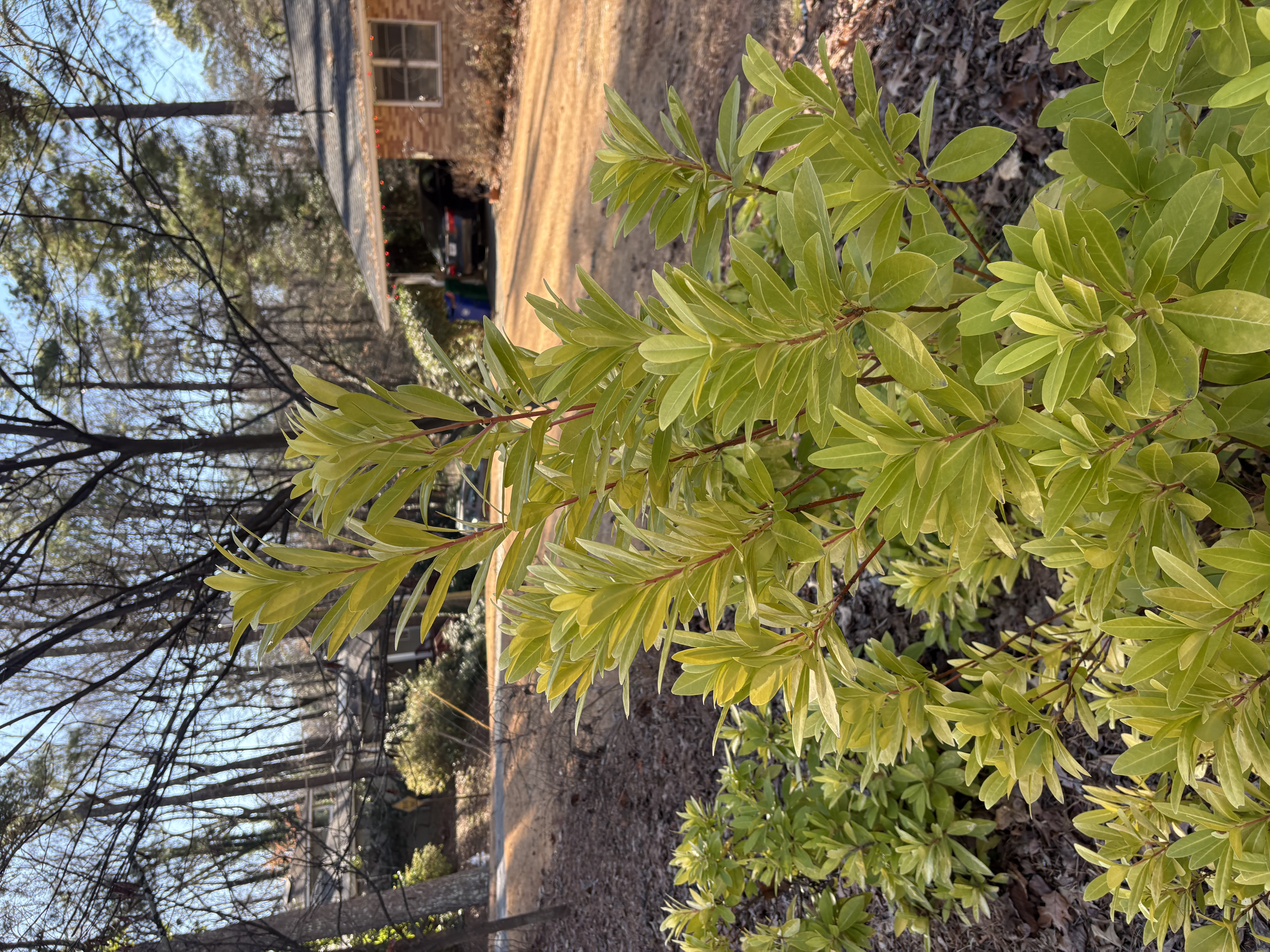
Lonicera nitida (boxleaf honeysuckle) - golden-leaved cultivar
Description
This plant appears to be a golden-leaved form of boxleaf honeysuckle (Lonicera nitida), a compact evergreen shrub commonly used in residential landscapes for hedges, borders, or mass plantings. The clues from the photo are the small, glossy, oval leaves that are bright chartreuse to lime in color, the multiple upright stems, and the overall low- to mid-growing habit. Leaves are typically 1–2 cm long, with a smooth margin, and they grow in pairs along slender stems, giving the shrub a dense, tidy appearance. The reddish or brownish young stems and the vibrant new growth are also characteristic of many golden Lonicera nitida cultivars. If you encounter a similar plant in person, you can confirm by noting: (1) leaf size and shape (small, oval, opposite pairs), (2) evergreen habit in milder climates, and (3) a tendency to form a dense, shrub-like mound without a single dominant trunk. While there are other golden evergreen shrubs that look similar, the combination of small leaves, evergreen nature, and frequent use as a low hedge in home landscapes makes Lonicera nitida a plausible identification for this specimen. Overview and key features - Growth habit: A compact, multi-stemmed evergreen shrub that can reach roughly 2–6 feet tall and about 3–6 feet wide, depending on cultivar and pruning. In landscapes, it is often kept much shorter through regular shaping. - Foliage: Small, oval to oblong leaves 1–2 cm long; margins smooth; new foliage is bright lime or yellow-green and tends to fade slightly to a deeper green as it matures. The overall effect is a sunny, golden glow in borders or hedges. - stems and form: Stems are slender and woody with a reddish-brown hue, producing a dense, shrub-like silhouette. The plant tolerates shearing well, which is why it is popular for manicured hedges and topiary-like shapes. - Color and seasonality: Year-round evergreen foliage in temperate climates, with the most striking color in full sun when new growth emerges bright yellow-green. - Use in landscape: Ideal for low hedges, edging, foundation plantings, or mass planting. It can also be grown in containers with careful pruning. Cultural requirements and care Light - Best color and vigor are achieved in full sun to light shade. In very hot or reflective climates, some partial shade during the hottest part of the day helps prevent leaf scorch and keeps the yellow foliage from fading to pale or bleached tones. - In deep shade, the foliage tends to become greener and the vibrant golden color can diminish, though the plant will still maintain its evergreen habit. Soil and drainage - Tolerant of a wide range of soil types, from sandy to clay, as long as the drainage is acceptable. The plant dislikes consistently wet feet, so well-drained soil is important. - It generally prefers slightly acidic to neutral pH, but is adaptable across a broad pH range. Watering - Once established, it is relatively drought-tolerant but performs best with regular watering, especially in hot, dry summers. Keep the soil evenly moist but not waterlogged. - In pots, monitor moisture closely; containers can dry out quickly, so more frequent watering and careful drainage are key. Fertilization - Apply a balanced, slow-release fertilizer in spring as new growth begins. A light top-dressing of a 10-10-10 or 12-6-6 formulation or a specialized evergreen shrub formula supports steady growth and maintain color. - Avoid over-fertilizing, which can lead to excessive soft growth that is prone to disease and reduces the intensity of the golden color. Pruning and training - Pruning is a major part of care for this plant, both for height control and for maintaining a neat, compact shape. Light pruning can be done after any major flush of growth or after flowering if the cultivar does produce noticeable blossoms. - Heavy pruning should be avoided in late summer to prevent stimulating new growth that won’t harden off before winter, depending on your climate. - To maintain a hedge or edging, shear lightly a few times a year, removing just small sections to shape evenly. For a more natural mound, selectively trim to remove any leggy growth while encouraging denser branching. - If a plant becomes leggy or sparse in the center, you can selectively prune back older, woody stems to encourage new shoots from the base or from lower buds. Growth considerations and longevity - Lonicera nitida is slow to moderate in growth rate, which makes it a good option for low hedges and borders that don’t require constant maintenance. With regular pruning, plants maintain a tidy, compact appearance for many years. - It is relatively hardy in many regions (often grown in USDA zones 6–9, with winter protection sometimes needed in the far north). In extremely cold climates, some leaf drop or reduced vigor may occur, but the plant generally recovers well once temperatures moderate. - The golden foliage can be more susceptible to sun scorch in extremely hot, dry climates, so some shade or afternoon protection can help preserve color. Pests, diseases, and problems - Pests: Boxleaf honeysuckle can encounter common ornamental pests such as aphids, scale, and spider mites, especially on stressed plants. Regular monitoring and early treatment with insecticidal soap or horticultural oil can keep populations under control. - Diseases: Powdery mildew or leaf spots can occur in humid conditions. Good air circulation, avoiding overhead watering, and proper spacing between plants help prevent issues. If leaf spots appear, removing affected leaves and ensuring proper sanitation around the plant helps. - Environmental stress: Overwatering or poorly drained soils can lead to root rot. Ensure good drainage and avoid water-logged conditions. Underwatering in hot periods can cause leaf scorch and reduce the intensity of the yellow color. Propagation and new plant establishment - Propagation is commonly done by semi-hardwood cuttings taken in late summer to early autumn or by layering. Cuttings rooting in a well-draining potting mix with bottom heat can establish fairly readily. - Seeds are not typically used for home propagation due to variability and slower establishment. Winter care and seasonal tips - In milder climates, the plant remains evergreen through winter, though some leaf drop can occur during cold snaps. A layer of mulch in late fall helps protect shallow roots and keeps the root zone stable. - In regions with freezing temperatures, protect younger plants with mulch and consider placing the plant in a sheltered bed or microclimate if extreme cold is expected. Common landscape integration ideas - Hedges and borders: The uniform, dense growth makes it ideal for low hedges and edging along walkways or driveways. - Foundation plantings: A row of golden Lonicera nitida can brighten a foundation bed with year-round color. - Mass plantings and containers: It performs well as a mass specimen in shrub borders or in pots, where regular pruning maintains a compact, pressed look. - Mixed beds: Pair with flowering perennials or evergreen conifers to create layered textures and contrast between color and foliage forms. What to do if this isn’t the exact plant - If the leaves are oppositely arranged and the plant has extremely small, nearly round leaves, it could be a different evergreen such as a golden boxwood cultivar or an escallonia. If the new growth color is very intense but the leaves are larger or arranged differently, your shrub could be a different genus. A quick check is to look at leaf arrangement under a close inspection: opposite leaves indicate the genus Lonicera or some other, whereas alternate leaves would point toward a different group. If in doubt, taking a few clear photos and comparing with local nursery guides or asking a horticulturist can help confirm the exact cultivar. Bottom line - The plant in your photo most closely resembles a golden-leaved boxleaf honeysuckle (Lonicera nitida) or a very similar evergreen shrub used for golden foliage in landscapes. It’s valued for its bright year-round color, compact habit, and versatility in hedges, borders, and containers. With proper light, soil, and pruning, it can stay healthy, maintain its color, and keep a tidy shape for many seasons. Regular monitoring for common pests, attention to drainage and watering, and a sensible pruning regimen will help preserve its vibrant appearance and structural integrity in your garden.
Identification Time
January 1st, 2026
Notice
The function of Plantypia is using AI, so it may be inaccurate. Please use it for fun and reference only.
A plant result page that leads to the next useful action
After checking the name, continue into official plant database results.