Weeping Fig (Ficus benjamina)
Description
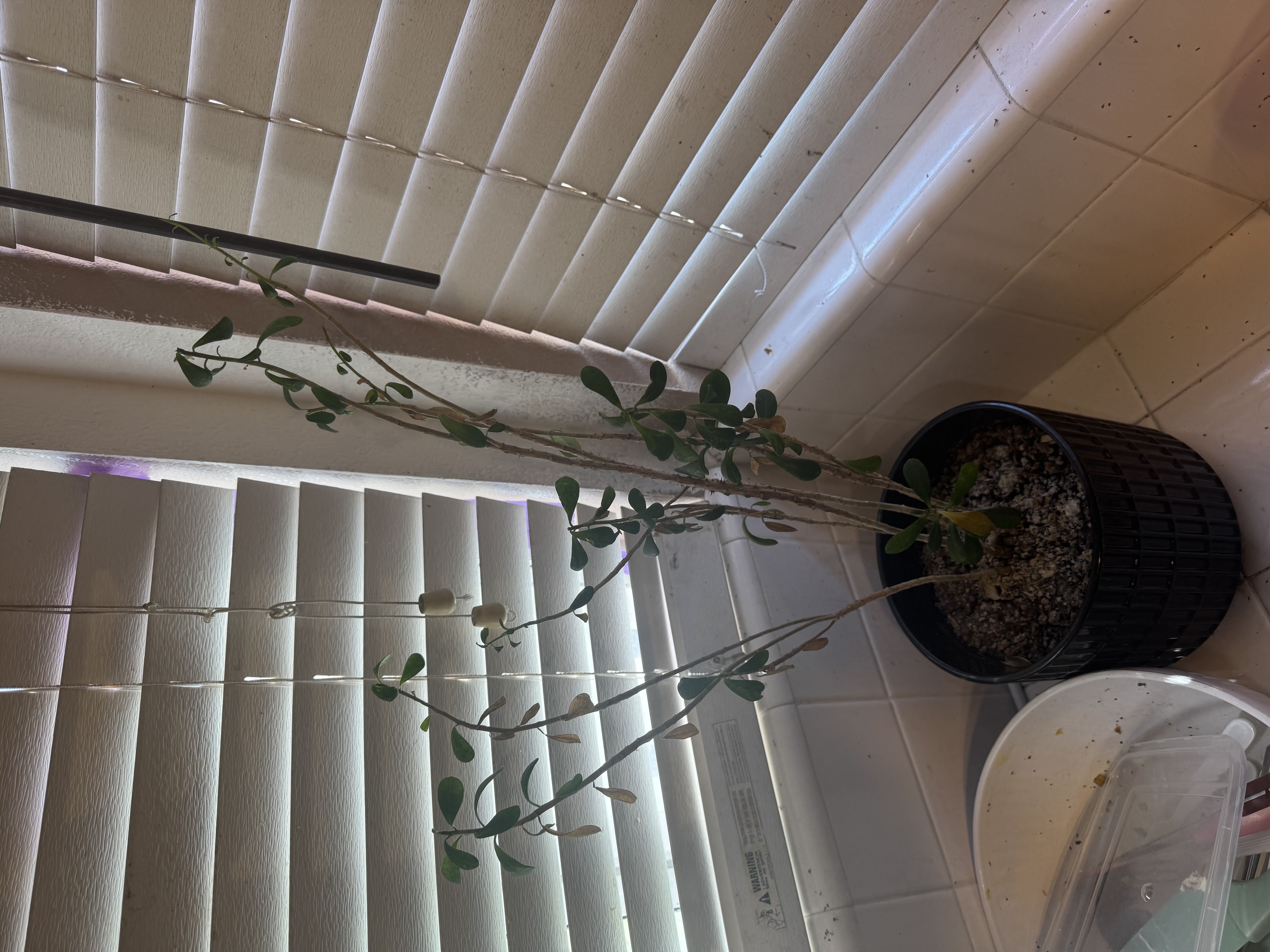
The plant shown in your photo closely resembles a weeping fig, Ficus benjamina, a popular evergreen tree in the fig family that is widely grown as an indoor houseplant or as a small patio tree in warmer climates. In indoor settings it often grows as a leggy specimen with slender, woody stems and a sparse tuft of small, glossy oval leaves toward the tips. The leaves are typically dark green, smooth, and leathery, with a pointed or rounded tip depending on the cultivar, and a distinct central vein that runs the length of the blade. Older stems may have light gray to brown bark, while new growth has a fresher, greener appearance. The plant in your photo appears to be in a low-light, indoor corner beside a window with blinds, which commonly results in leggy growth as the plant stretches toward the light. This is a very typical situation for a ficus kept indoors without bright, direct sun, and it does not necessarily indicate a severe health problem; rather, it offers an opportunity to prune and shape the plant back into a fuller, more balanced form. Ficus benjamina is native to tropical and subtropical regions of Asia and Australia, where it grows as a slender tree with a broad, glossy canopy. When cultivated indoors, it behaves like a slow to moderate grower, depending largely on light, temperature, and moisture. It is often used as a bonsai species because its growth habit readily responds to pruning and wiring, and it tends to branch from node points along the stems. In the home, a ficus can reach several feet in height if given adequate light and regular pruning, though many indoor plants remain comfortably smaller due to pot size and pruning. The overall look of a ficus on the window sill is one of elegance and a touch of drama, especially when the top leaves form a compact crown, contrasted against bare and slender trunks. Care for a weeping fig begins with light. Bright, indirect light is ideal. A location that receives several hours of filtered sun or bright indoor light will encourage dense, even growth and help maintain leaf size. If the plant is kept in a corner with minimal light, it tends to become leggy, with longer internodes and smaller, sparser leaves. If you notice leaf drop or a dramatic slowdown in growth, consider moving the plant to a brighter spot, such as a few feet from a sunny window (still avoiding harsh, hot direct sun that can scorch leaves). Temperature should be stable and comfortable for tropical plants: generally between 60 and 75 degrees Fahrenheit (15 to 24 degrees Celsius). Avoid sudden temperature fluctuations, drafts from doors or windows, and exposure to cold air, as ficus species dislike cold shock. Humidity is beneficial, though a ficus can tolerate ordinary indoor humidity. If your bathroom environment is humid, that can be favorable, but most indoor rooms with average humidity are acceptable as well. Occasional misting can help humidity a bit, especially in dry climates, but it is not strictly required if you provide a bright location away from dry heat sources. Watering is a critical part of ficus care. Water the plant thoroughly when the top inch (2.5 cm) of the soil feels dry to the touch. The exact frequency depends on the potting mix, container size, and indoor climate, but a common pattern is every 5 to 10 days in warmer months and less often in cooler months. It is important to ensure the pot has good drainage and that water does not sit in a saucer or in the pot for extended periods, as soggy soil can lead to root rot. If you observe yellowing leaves, soft stems, or a sour smell from the soil, these can be signs of overwatering. Conversely, very dry, crispy leaf tips, leaf drop, or wilting can indicate underwatering. A consistent moisture level that avoids both extremes helps the plant maintain healthy growth. Water quality matters as well; if your tap water is very hard or heavily chlorinated, using filtered or rainwater can sometimes improve leaf quality and reduce tip burn. Soil and repotting are the next keys to health. Use a well-draining potting mix designed for indoor tropical plants. A standard mix that contains components like peat or coco coir, perlite or pumice, and a bit of compost works well. Because ficus plants can tolerate a range of soil conditions but dislike being root-bound, repotting every 2 to 3 years, or when the plant visibly becomes root-bound, is typically appropriate. Choose a pot that is only slightly larger than the current one and includes drainage holes. When you repot, gently loosen the roots and trim any kept-back or rotting roots to encourage new, healthy growth. Fertilization supports vigorous growth, especially during the active growing season. Use a balanced, water-soluble fertilizer with a ratio such as 10-10-10 or 20-20-20. Feed every 4 to 6 weeks from spring through early autumn, and cut back or pause feeding in late autumn and winter when growth naturally slows. Do not over-fertilize, as excess salts can accumulate in the soil and cause leaf burn or marginal browning. If you prefer organic options, a diluted fish emulsion or seaweed-based fertilizer can be used sparingly. Pruning and training are part of the beauty of the weeping fig. Regular pruning helps maintain a compact, well-shaped plant and invites bushier growth rather than tall, spindly canes. To encourage a fuller silhouette, prune back leggy shoots just above a leaf node, which will encourage new growth at that point. If your goal is to train the plant as a small tree or a bonsai, you can selectively prune and wire branches to shape the crown. When performing pruning, keep in mind that ficus can exude a milky sap when cut. If you have sensitive skin or are pruning many stems, wearing gloves is prudent. After pruning, a small amount of fresh growth usually appears at the cut sites within a few weeks under appropriate light and temperature. Propagation is another facet of ficus care that many enthusiasts enjoy. Ficus benjamina can be propagated relatively easily through semi hardwood cuttings taken during the growing season. Choose healthy shoots, cut a section about 4 to 6 inches long, and remove the lower leaves. Dip the cut end in rooting hormone and plant it in a well-draining potting mix. Keep the cuttings consistently moist (not soggy) and place them in a bright, warm location with indirect light. Roots typically form in a few weeks to a couple of months, after which the new plant can be potted separately. Pests and diseases are uncommon but possible. The most frequent pests are scale insects, mealybugs, and spider mites. Regular inspection of the undersides of leaves helps catch early infestations. If pests occur, wipe leaves with a damp cloth or apply a gentle horticultural soap or neem oil, following label directions. Ficus can also be susceptible to root rot if kept in waterlogged soil, so ensuring proper drainage is essential. Leaf drop can also occur due to sudden changes in light, temperature, or humidity, or from a move to a new home. If leaf drop happens after a change, simply give the plant a bit of time to adapt, and maintain stable conditions to recover. Cultural and care notes to consider with your current leggy specimen: a plant that is growing in low light often drops lower leaves and puts more energy into limb extension toward the nearest bright light source. If you want to restore fullness, consider gradually moving the pot closer to the window or providing a brighter indirect light source. You can also prune several of the longer, bare stalks back near the base to encourage multiple new growth points from the remaining nodes. After pruning, keep up with a consistent watering and feeding routine to support the plant as it reestablishes a denser canopy. A healthy ficus will usually respond with vigorous new growth in a few weeks to a couple of months under favorable conditions. Safety and practicality notes: while ficus benjamina is an attractive indoor tree, it is mildly toxic to pets and humans if ingested. The sap can irritate the skin for some people, and ingestion can cause digestive upset. If you have curious pets or small children, position the plant out of reach or supervise access to it. Always wash your hands after handling the plant or pruning, and store any cuttings away from children and animals. In summary, the plant in your photo is most consistent with a weeping fig, a classic indoor ficus that can be grown as a small tree or bonsai-like specimen. Its glossy leaves, slender trunks, and graceful habit make it a favorite for interior spaces, though it requires attention to light, water, and general care to stay robust. With bright, indirect light, stable temperatures, a well-draining soil, and a sensible watering and feeding routine, your ficus can recover its fullness, produce healthy new growth at the tips, and provide years of visual appeal. If you are currently dealing with a particularly leggy form, a simple pruning and repositioning toward more light can work wonders, and you can gradually reestablish a fuller, more balanced canopy while maintaining the plant’s elegant silhouette.
Identification Time
September 6th, 2025
Notice
The function of Plantypia is using AI, so it may be inaccurate. Please use it for fun and reference only.
A plant result page that leads to the next useful action
After checking the name, continue into official plant database results.