Unknown young tree/seedling (unclear species from photo)
Description
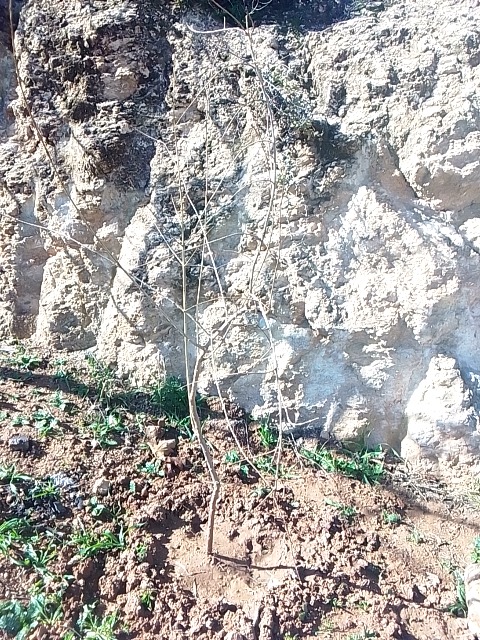
The plant shown in the photo appears to be a young woody tree or a large shrub seedling rather than a herbaceous plant. It has a slender, smooth-barked main stem that rises to about knee height or higher, with several very thin lateral shoots extending from the upper portion of the plant. The overall silhouette is tall and narrow, with the branching concentrated toward the top, which can give a vase-like or umbrella-like shape in young trees. The plant is growing in bare, rocky soil at the base of a limestone-like wall, with minimal ground cover around it. The stems are leafless in this image, which makes precise identification difficult, because many deciduous trees are indistinguishable at this stage when they have not yet produced leaves or flowers. Identifying this seedling with high certainty is not possible from a single leafless shot. Several genera commonly establish as a pair of slender trunks that branch high up and form a sparse crown, especially in dry, rocky or roadside habitats. The description below presents the most likely possibilities and provides practical care guidance that will be broadly suitable for a young tree of unknown species. If you can provide additional photos later in the season showing leaves, buds, flowers, or fruit, I can refine the ID more accurately. What you might be looking at, depending on the region, includes: - Willows (Salix) or poplars (Populus): These genera often produce fast growth, slim trunks, and branches that start high on the trunk. Willows especially can form very slender, twiggy crowns when young and in dry microclimates where water is limited. If the site is near damp ground, creek banks, or has even occasional moisture, willow or poplar seedlings are common candidates. - Elm (Ulmus) or other deciduous trees: Some young elms and other broad-leaved trees can appear as tall, sparse little trees early in development before leaves fill in. The branching pattern (upper-portion branching, relatively few side branches) can resemble several deciduous species at this stage. - Ornamental or fruiting trees: Some cultivated ornamentals or fruit trees (for example certain plums, cherries, or almonds) can have a similar early growth habit when young, especially if the stem is protected or stress-prone and has not yet produced leaves. Key cues to look for when leaves appear: - Leaf shape and arrangement: Willows typically have narrow, lance-shaped leaves; poplars have triangular to rounded-ovate leaves; elms have oval leaves with an asymmetric base and serrated margins. Observing whether leaves are opposite (rare in many trees) or alternate on the twig can help. Bud type (terminal vs. lateral) is also informative. - Bark texture: As the seedling matures, bark texture may change from smooth to cracked or furrowed. Willows and poplars often show smoother, greenish-gray bark when young, while elms develop more pronounced ridges. - Flowers or catkins: Some trees (willow, poplar, hazel, and others) produce catkins or bloom before or with leaves. Seeing any blossoms or catkins later in spring or early summer can be decisive. Even before a positive species ID is possible, you can start a solid care routine that will support healthy development. The following care guidelines apply broadly to most young trees and are designed for a plant growing in bare or rocky soil with limited competition and occasional water stress. Site and planting considerations - Sun exposure: Most temperate-zone deciduous trees prefer full sun to light shade. Aim for at least 6 hours of direct sun daily for robust growth unless the eventual species is known to tolerate heavy shade. - Soil and drainage: Rocky or compact soil dries quickly and drains rapidly. If the plant is newly installed or transplanted, amending the planting area with a layer of well-rotted compost or organic matter can improve soil structure and moisture-holding capacity without causing waterlogging. Ensure there is a gentle slope or collection area to prevent water pooling around the roots. - Planting depth and stability: The seedling should be planted at the same depth it occupied in the container or nursery soil. If the roots are exposed, cover them gently with soil and firm it lightly. Since the stem is tall and slender, secure with stakes to prevent wind damage until the trunk thickens and gains rigidity. Watering and moisture management - First season: Establishing roots is critical. Water deeply and infrequently rather than shallow, frequent watering. In dry periods, provide a thorough soak every 5–7 days, adjusting for rainfall. In cooler, wetter climates, reduce frequency accordingly. - Mulching: Apply a 2–3 inch (5–7 cm) layer of organic mulch around the base of the plant, extending a few inches away from the trunk. This helps conserve soil moisture, moderate temperature, and discourage weed competition. Keep mulch a little way from the trunk to avoid rot. - Avoiding drought stress: If the site experiences extreme sun or wind, consider a partial shade protection during the hottest part of the day for the first few weeks, gradually increasing sun exposure as the plant acclimates. Support, staking, and pruning - Staking: Given the slender, tall habit, staking is often helpful for the first year or two. Use two stakes and a flexible tying system (fabric ties or rubber ties) so the trunk can sway slightly, which promotes natural hardening. Avoid tying too tightly or tying directly around a growing trunk—allow some movement. - Pruning for structure: In the first growing season, prune only to remove dead, damaged, or crossing branches. Do not aggressively shape the crown too early; a natural growth habit will produce a stronger trunk and better future form. In subsequent seasons, aim to open the canopy low by encouraging a few strong branches to form a central leader (one main trunk) and several well-spaced scaffold limbs. - Removing suckers or watersprouts: If you notice multiple shoots emerging from the base or along the trunk, prune these competition growths to direct energy to the primary trunk and chosen main limbs. Fertilization and soil nutrition - Baseline: If the soil is reasonably fertile and the plant is in a sunny, well-drained site, you may not need any fertilizer in the first year. Excess nitrogen can spur leafing at the expense of root establishment and trunk strength. - Soil testing: If growth seems slow or leaves appear pale in color (once they emerge), consider a soil test. A balanced, slow-release fertilizer applied in early spring can be appropriate if a deficiency is indicated. Follow package directions to avoid over-fertilization. - Organic options: A yearly top-dressing of compost around the root zone can improve soil structure and microbial activity, benefiting root development and resilience. Pests, diseases, and general health monitoring - Common issues: New trees can attract aphids, scale insects, caterpillars, and fungal diseases such as powdery mildew or leaf spots, particularly in damp conditions or poor air circulation. Regular inspection and early intervention are key. - Prevention practices: Ensure good air circulation by not crowding plants, avoid overhead irrigation when possible, and remove fallen leaves or debris that can harbor pests and pathogens. - Action steps: If pests are observed, identify them (a local extension service or nursery can help) and choose targeted, least-toxic controls. For many seedlings, strong, healthy growth and correct watering practices go a long way toward natural pest resistance. Seasonal care and long-term expectations - Spring: As temperatures rise, your seedling should resume growth. Watch for the first sign of leaf buds swelling; this is the best moment to note leaf shape and growth habit, which will help with species identification. If buds look lethally damaged by frost, protect the plant with a light cover designed for low temperatures. - Summer: Maintain steady moisture, watch for wilting during heat waves, and prune only as needed to maintain a strong branch structure. If competition from nearby plants is heavy, consider selective thinning to redirect resources to the seedling. - Fall and winter: In colder climates, mulch the root zone to insulate against freeze-thaw cycles. Prune only after the tree has entered dormancy unless you need to remove dead wood. Avoid heavy pruning late in the season as it can stimulate new growth that is susceptible to frost damage. Growth expectations and eventual form - Growth rate varies widely by species. A willow or poplar seedling, if it is indeed one of those, can grow quite rapidly under good moisture and sunlight conditions, potentially reaching several meters in a few years. An elm or similar decider may grow more slowly but can develop a strong structural form. - Eventually, the plant may develop a single dominant trunk with a wider crown or maintain a multi-stemmed habit depending on the exact species and pruning regime. If you want a single-trunk tree for a landscaped look, plan to select one vigorous stem in the first one to two years and gradually remove or shorten the other stems to encourage trunk consolidation. Bottom line for now - From the current image, the plant is best described as a young, leafless deciduous tree or large shrub with a slender, vertical habit and elevated branching. It is not possible to determine a precise species without foliage, flowers, or fruit. The care recommendations above are designed to support healthy establishment and growth for most similar young trees regardless of exact identity. When leaves appear, you’ll be able to narrow the ID down significantly using leaf shape, arrangement, and any blooming structures. If you can share additional photos later in the season (including close-ups of any buds, leaves, or catkins), I can offer a more confident species identification and tailor the care advice to that specific plant.
Identification Time
January 12th, 2026
Notice
The function of Plantypia is using AI, so it may be inaccurate. Please use it for fun and reference only.