Common burdock (Arctium spp.)
Description
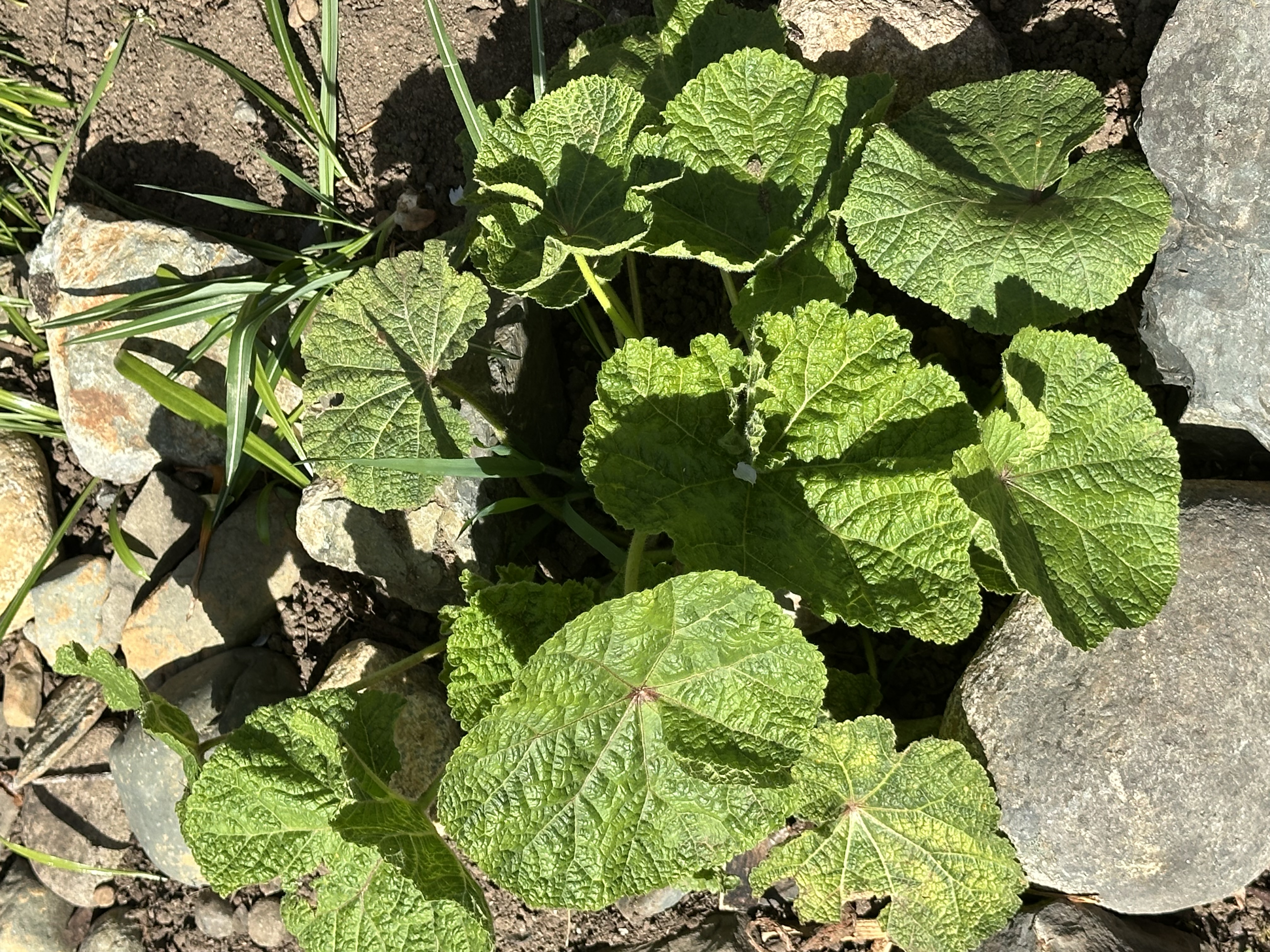
The plant shown appears to be a Common burdock (Arctium spp.) in its rosette stage. The broad, oval to heart‑shaped leaves sit low to the ground, forming a dense basal cluster. They are large, with a strongly wrinkled, textured surface and prominent venation. The upper leaf surface is a vivid green, while the underside is usually pale and wooly to a degree. The leaf margins are gently toothed or wavy rather than sharply serrated, and the petioles (leaf stalks) are relatively long and sturdy, lifting the blade slightly above the soil. In rosette form, these leaves lay flat against the ground, helping the plant store energy in its root system for the subsequent year’s growth. In late spring or early summer of the second year, burdock commonly sends up tall flowering stalks crowned with clusters of burrs that cling to fur and fabric, which is one of the most recognizable features of mature plants. The overall habit of the plant in the photo—compact, leafy, and clump‑forming—fits the typical first‑year appearance of burdock rather than an established garden perennial. The plant belongs to the Asteraceae family and is notorious for its burrs, which is why it is often regarded as a weed in managed landscapes. The pictured specimen has the classic look of a young burdock rosette: large, crinkled leaves radiating from the center and a robust, earth‑storing root system beginning to develop beneath the surface. What it is and how it grows: - Life cycle: Burdock is a biennial. In its first year, it forms a robust rosette of large leaves close to the ground. In the second year, it typically bolts a tall flowering stalk (often reaching several feet) bearing dense clusters of small flowers that mature into burrs. The burrs are the plant’s most infamous feature because they latch onto fur, clothing, and animal hair, aiding in seed dispersal. - Leaves: Leaves are large and can exceed 30 cm (12 inches) in mature plants, though younger rosettes are smaller. The texture is rough and hairy on the underside, with the upper surface being green and wrinkled. The venation is prominent, giving the leaf a quilted or crinkled appearance. The leaf bases are heart‑shaped, and the blades taper toward the tip. - Habitat: Burdock tolerates a wide range of soils but prefers disturbed ground, roadsides, fields, and garden margins. It does best in rich, well‑drained soil with full sun to light shade. In a garden, a dense rosette like the one shown can establish quickly if not managed. How to distinguish it from look‑alikes: - Butterbur (Petasites species) can have similar pre‑flowering leaves, but butterbur leaves typically become much larger (often very big) and are usually found in very moist soil along riverbanks or damp borders. Butterbur leaves sit on longer petioles and have a more umbrella‑like appearance as they mature. Burdock leaves are generally more elongated and heart‑shaped with a rough texture, whereas butterbur leaves tend to be more rounded and can be broader at the blade. - True dock (Rumex) leaves can resemble burdock from a distance, but dock leaves are usually narrower, with different venation and habit (often not forming such a dense basal rosette in the same way). - Some hollyhock or fig‑leaf relatives also have large, wrinkled leaves, but their leaf shapes, petiole attachments, and growth forms differ markedly (hollyhocks are typically more deeply lobed and tall when they bloom). Care and management in a garden setting: - If you want to remove it: Burdock is persistent because of its taproot. When removing a rosette, try to dig up the entire root to prevent resprouting. The best time is on a moist day when the soil is loosest. Wear gloves, as the plant’s rough texture and any burrs that form later can irritate skin and clothing. If you encounter burrs later in the season, handle plants with care to avoid burr spread. - If you want to keep it: Some gardeners tolerate burdock for its big, decorative leaves early in the season or for edible uses. If allowed to grow, be prepared for a second‑year flowering stalk and burrs, which will then spread seeds widely. In a rock garden or ornamental space, you may want to prune or restrict it so it does not crowd nearby plants. - Cultural control tips: Regular mowing or cutting back the rosette before it bolts can reduce the energy stored in the root and help keep the plant from flowering. Mulching can suppress the emergence of new rosettes in the surrounding area, but avoid heavy, damp mulch that could encourage rot in a dense rosette. - Competition and spacing: If a burdock plant is allowed to mature, the second‑year stalks require plenty of space and can shade out other perennials. In a garden bed, allocate space or remove aggressively to prevent spread. If you are growing other perennials nearby, consider companions that form a dense cover to minimize bare soil where burdock can establish rosettes. - Soil and water: Burdock tolerates a variety of soils but prefers well‑drained, fertile ground. Too much moisture in poorly drained soil can promote disease or root rot, especially in a crowded rosette. In drier climates, supplemental irrigation can help, but avoid waterlogging. Edible and medicinal notes (with cautions): - Burdock root is edible and has a long history in traditional cuisines. In East Asian cooking (notably Japanese), burdock root (called gobo) is cleaned, peeled, and cut into thin matchsticks or coins for kinpira or tempura, often with a sesame or soy glaze. The young leaves can also be eaten when small, though they are generally tougher and more bitter as the plant matures. Proper preparation is important to remove bitterness and any potential latexy sap. - The plant contains inulin and other carbohydrate compounds, and traditional herbal use has included diuretic and anti‑inflammatory applications. If you are considering using burdock for edible or medicinal purposes, start with a small amount and be aware that some individuals may have allergies or skin sensitivities. Always source from a non‑invasive stand and avoid using if you have a known sensitivity to related plants. - Caution: Do not harvest wild burdock from streets or contaminated soils where pollution or pesticides may be present. If grown in a garden bed, use clean soil and avoid applying herbicides that could be taken up by the plant and transfer to edible parts if you decide to consume them. Propagation and spread: - In managed settings, burdock can be propagated by seed or by transplanting rosettes. Seed germination is typically easy in warm soils, so if you are cultivating it intentionally, sow seeds in late spring to early summer with light coverage. If you are removing it, make sure to collect or destroy burrs and prevent seed dispersal to minimize spread. - For ornamental purposes, some gardeners cultivate burdock as a novelty rosette plant, but it requires careful management to avoid unwanted spread and to protect neighboring plants from crowding. Ecological notes and landscape considerations: - Burdock often coexists with early‑season weeds and disturbance. In some environments, it may provide temporary ground cover and reduce soil erosion for a season, but its aggressive growth and tendency to form burrs mean it is usually best kept under control within a cultivated landscape. - If you are transitioning a rocky or poor‑soil bed to a more stable planting scheme, consider replacing burdock with perennial groundcovers or compact perennials that offer similar visual impact (large, textured leaves) without the weedy potential. Native or noninvasive alternatives can provide a similar silhouette while reducing management needs. In summary, the plant in the photo matches the rosette form of common burdock—a biennial weed known for its large, wrinkled leaves and, later, its burr‑bearing flowering stalks. While not typically grown as a decorative foliage plant, burdock has a storied history in traditional cuisine and herbal uses. If you decide to manage it, focus on removing the root to prevent regrowth, monitor for second‑year bolting, and consider replacement with intentional plantings to maintain the look you want in the rock garden. If left unchecked, burdock can become persistent and spread through burrs, so early identification and proactive management are the keys to keeping it under control.
Identification Time
April 20th, 2026
Notice
The function of Plantypia is using AI, so it may be inaccurate. Please use it for fun and reference only.
A plant result page that leads to the next useful action
After checking the name, continue into official plant database results.