Portulaca (Rose moss) — likely *Portulaca grandiflora*
Description
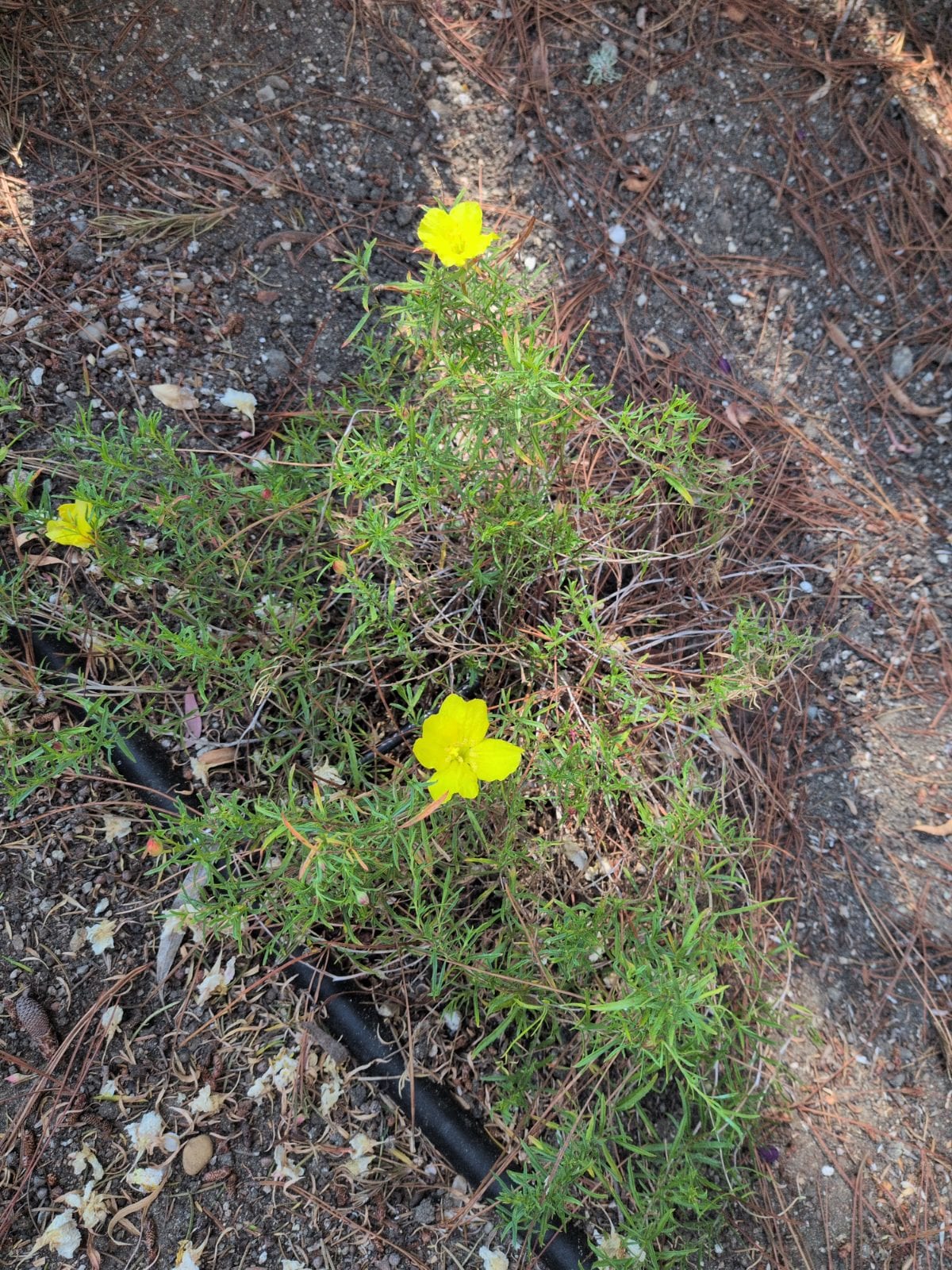
The plant in the photo appears to be a yellow-flowering purslane-type succulent, most consistent with Portulaca (commonly called rose moss; often *Portulaca grandiflora* when grown as an ornamental). It forms a low, spreading mat of fleshy, bright-green stems and narrow, somewhat cylindrical leaves. The flowers are vivid yellow and relatively large compared with the size of the foliage, arising at the tips of short stems. This genus is well known for its hardy, drought-tolerant, sun-loving habit—plants often look like they “wait” for sun and warmth, then burst into bloom. ### Key characteristics - **Growth form:** Low-growing, ground-hugging, creeping or spreading. Stems are slender to somewhat thickened and can root where they contact the soil. - **Leaves:** Small, narrow, smooth, and fleshy (succulent). They help the plant conserve water. - **Flowers:** Bright yellow (sometimes pink/white/red in other cultivars), typically with a conspicuous central area and many petals depending on cultivar. Flowers are usually held above the foliage. - **Flower behavior:** In Portulaca, blooms commonly open in strong sunlight and may close or fade during cloudy/rainy weather or later in the day (varies by species/cultivar). - **Habitat impression:** Plants of this group often thrive in disturbed, sandy, gravelly, or hot locations where drainage is excellent. ### Where it grows (and why it looks “happy” in harsh ground) Portulaca species are native to warm regions and have become popular ornamentals in many climates because they tolerate heat, drought, and poor soils. They are often seen in: - Dry landscapes and sandy soil - Sidewalk cracks and gravel beds (especially in warm areas) - Container gardens in full sun - Naturalized spots near roads or disturbed ground Because the pictured plant is thriving directly in a gritty, dry-looking roadside or garden bed, the overall environmental match strongly fits the Portulaca lifestyle. ### Care guide (growing it successfully) Portulaca is among the easiest “forget-me-not” flowering plants for hot weather, but it does have a few specific preferences. #### 1) Sunlight - **Best:** Full sun—ideally at least 6–8 hours of direct sunlight. - **If light is insufficient:** Plants may become leggy, bloom less, and look less compact. - **Practical tip:** If you are growing it in a container, place it where it gets the most sun you can provide. #### 2) Soil and drainage - **Most important factor:** Excellent drainage. - **Recommended soil mix (containers):** A fast-draining cactus/succulent mix, or mix potting soil with plenty of sand/perlite/pumice. - **In ground:** Works well in sandy or rocky soils. If your soil is heavy/clay, raised beds or amending with grit/sand can help. - **Avoid:** Waterlogged conditions, because fleshy stems/leaves can rot when kept wet. #### 3) Watering - **General rule:** Water only when the top layer is dry. - **Newly planted:** Water more regularly for establishment (still aiming for “dry then water” rather than constant moisture). - **Established plants:** Typically drought-tolerant; often only need watering during long dry spells. - **Warning signs:** - Yellowing or collapsing stems can indicate overwatering/rot. - Shrivelled leaves may just mean it’s conserving water (often reversible once watered). #### 4) Fertilization - **Typical approach:** Light feeding rather than heavy feeding. - **Option:** Use a balanced fertilizer at low strength occasionally, or a fertilizer formulated for flowers. - **Avoid too much nitrogen:** Excessive nitrogen can promote foliage at the expense of blooms. #### 5) Temperature and season - **Heat tolerance:** Strong. Many Portulaca types handle hot summers well. - **Cold sensitivity:** Generally does not like frost. If temperatures drop near freezing, growth may stall and plants can die back. - **Overwintering:** In regions with mild winters, it may survive outdoors. In colder climates, treat as an annual or grow in containers that can be protected. #### 6) Maintenance and pruning - **Deadheading:** Flowers are often short-lived; removing spent blooms can encourage more flowering. - **Trimming:** If the plant becomes messy or too sprawling, lightly trim it back to maintain shape. - **Weeding:** Keep the base clear early on so seedlings don’t compete. ### Propagation Portulaca is commonly propagated by: - **Seed:** Seeds germinate best with warmth and light. Sow on the surface and lightly cover (or press into the medium) depending on conditions. - **Cuttings (sometimes):** Because stems can root where they touch, taking stem cuttings can work, though seed is usually the easiest method. ### Common problems and solutions 1) **Root or stem rot (most common with overwatering)** - Cause: Moist soil, poor drainage, frequent watering. - Fix: Improve drainage, allow soil to dry more thoroughly, reduce watering. 2) **Few flowers** - Cause: Not enough sun, too much nitrogen, or cooler temperatures. - Fix: Increase sunlight, reduce fertilizer strength, and wait for warm conditions. 3) **Pests** - Portulaca can occasionally attract aphids or other small sap-suckers, especially in stressed conditions. - Fix: Rinse off with water; use insecticidal soap if needed. ### Related information (and cautions) - **Ornamental vs. weedy:** Some Portulaca species are cultivated for their bright flowers, while others can behave like “weeds” because of their ability to spread and reseed. - **Invasive tendency (region-dependent):** In some places, hardy purslanes can naturalize. If you’re concerned about spreading, deadhead before seed fully matures. - **Wildlife interactions:** Their nectar can attract small pollinators, especially when they are abundant in sunny conditions. ### How to confirm the ID Since the photo shows a strong match but not enough fine details (like exact leaf shape and flower petal arrangement) for a guaranteed species-level ID, here are quick checks: - **Flower petals:** Are the petals numerous and showy like a doubled ornamental? Or are they simpler (more like wild purslane)? - **Leaf shape:** More cylindrical/fleshy leaves point to ornamental *Portulaca grandiflora* types. - **Sun behavior:** Do blooms open strongly on sunny days? That’s typical for Portulaca. If you can share a close-up of the leaves and an individual flower (especially the petal structure), I can refine the identification from “Portulaca rose moss” to a more specific species or variety.
Identification Time
August 22nd, 2026
Notice
The function of Plantypia is using AI, so it may be inaccurate. Please use it for fun and reference only.
A plant result page that leads to the next useful action
After checking the name, continue into official plant database results.