Castor bean (Ricinus communis)
Description
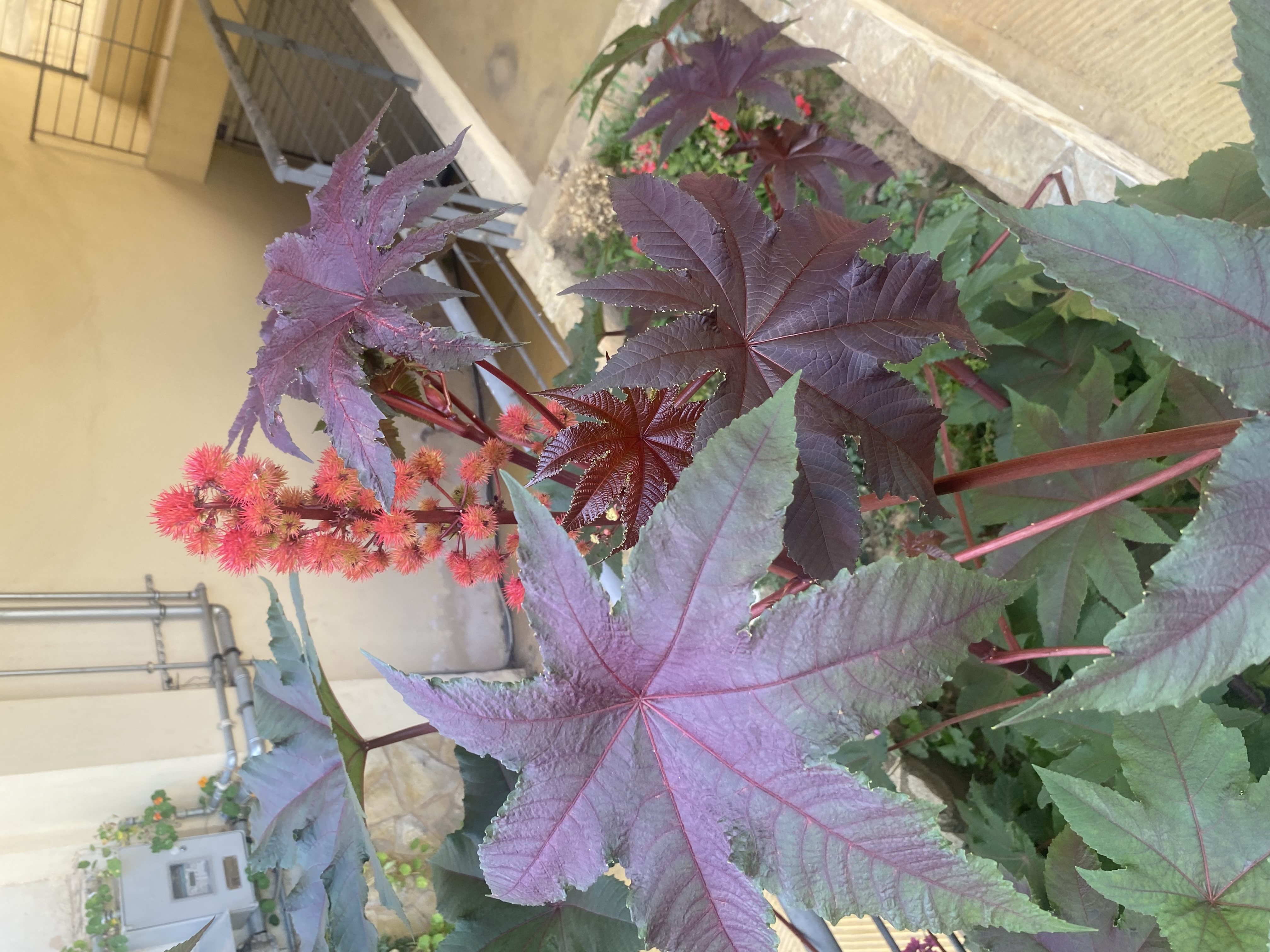
The plant in your photo is very likely Castor bean (Ricinus communis), an ornamental grown for its dramatic, large palmate leaves and showy, spiky inflorescences. The dark purple-maroon leaves with radiating veins and the tall flower spikes bearing dense, “bottlebrush” looking red to pink flowers match this species closely. Castor bean is fast-growing and can reach a shrub or small tree size in warm climates; however, in many places it is treated as an annual. ## Key characteristics (what you’re seeing) - **Growth habit:** Usually a single, upright stem when young, becoming branched with age. It is generally **rapid-growing** and can reach several meters tall in favorable conditions. - **Leaves:** Large, deeply **lobed, palmately divided** leaves (often 20–60 cm across) with strong veins. Leaf color can range from **green to purple/bronze/red**, and the long petioles (leaf stalks) may be reddish. - **Flowers/inflorescences:** Male and female flowers are produced on the same spike (a type of “raceme”). They appear as **dense, spiky clusters** that look like fuzzy brushes; in your image they’re **bright red/pink**, arranged on a tall central stalk. - **Fruit/seed features:** After flowering, it forms spiky capsules (often green to red-brown depending on cultivar). Each capsule contains seeds known as **castor beans**. ## Important safety note (please read) All parts of castor bean contain **ricin**, a highly toxic protein. This is not meant to scare you, but it is crucial for safe handling: - Keep children and pets from chewing leaves, flowers, or especially the **spiky seed capsules/seed beans**. - Wear gloves when pruning/handling if you have cuts on your skin. - Do not ingest any plant parts. ## Where it grows best - **Climate:** Loves warmth. Best outdoors in **spring and summer** when temperatures are consistently warm. - **Sun:** Full sun to light shade. More sun usually gives better growth and more intense leaf color. - **Soil:** Adaptable, but prefers **well-drained** soil with moderate fertility. - **Water:** Regular watering while establishing; drought tolerance is better once it is established, but flowering is best with steady moisture. ## Care guide (practical, step-by-step) ### 1) Sun and placement - Choose a spot with **at least 6–8 hours of sun** daily. - In very hot regions, afternoon light shade can help young plants if they show stress (wilting/scorch), but full sun is still generally ideal. ### 2) Soil and planting - **Well-drained soil** is essential. Castor bean roots can suffer if soil stays soggy. - If your soil is heavy clay, mix in compost and/or ensure the bed is raised. - For containers: use a large pot with drainage holes and a high-quality potting mix. Because it grows quickly and can become tall, choose a pot large enough to keep it stable. ### 3) Watering - **New plants:** Keep soil evenly moist (not waterlogged) for the first few weeks. - **Established plants:** Water when the top few centimeters of soil dry out. - **Avoid overwatering:** Yellowing leaves or persistent soggy soil can lead to root problems. ### 4) Fertilizing - Growth is vigorous, so some feeding helps. - Start with **compost** or a balanced slow-release fertilizer at planting. - During the active growing/leafing season, you can apply a balanced fertilizer every 4–6 weeks (or follow the product label). - If leaves become overly lush but flowering is weak, reduce nitrogen a bit and ensure enough sun. ### 5) Pruning and training - Castor bean usually does not require heavy pruning, but you may pinch the top early to encourage branching if you want a fuller plant. - Remove damaged or diseased leaves as needed. - If you are growing it as a specimen plant, leave the main stem for height and structural strength. ### 6) Pollination and flowering - Castor bean is typically wind- or insect-assisted (many insects visit), but it still often sets seed readily where conditions are warm. - If you don’t want volunteers/seed spread, consider removing spent flower spikes before seed capsules fully mature. ### 7) Mulching - A light layer of mulch helps conserve moisture and stabilizes soil temperature. - Keep mulch slightly away from the main stem to reduce rot risk. ## Pests and problems (what to watch for) Castor bean is generally resilient, but common ornamental issues include: - **Aphids** (especially on tender new growth). A strong water spray or insecticidal soap can help. - **Spider mites** in hot, dry conditions (often show as fine webbing or stippling on leaves). Increase humidity where possible and treat early. - **Leaf spot or fungal issues** if conditions are too damp or airflow is poor. - **Root rot** from overwatering or poor drainage. ## Propagation and seasonality - **Seed (castor beans):** Commonly propagated by seeds. Germination can be improved by nicking or soaking (but handle seeds carefully due to toxicity). - **Annual behavior:** In cooler climates it behaves like an annual because it does not tolerate frost. - **Warmth matters:** Sow after the risk of frost and when soil warms. ## Container growing tips If you’re growing it in a planter like in the background of your photo: - Use a **large pot** (small pots limit root development and can reduce flowering). - Ensure excellent drainage and avoid waterlogging. - Provide a sturdy stake/support if it gets tall and windy. - Feed lightly but regularly, since nutrients in containers wash out faster. ## Related information: ornamental value and uses - **Ornamental impact:** The contrast between dark foliage and vivid spiky flowers makes it a striking centerpiece plant. - **Castor oil industry:** While the plant is famous for castor oil production, remember that oil and especially **the seeds** are processed industrially for safety reasons; you should not attempt home extraction. ## Final thoughts From your image—especially the combination of **purple/red lobed leaves** and **tall red spiky flower clusters**—castor bean (Ricinus communis) is the most likely match. With plenty of sun, warm conditions, and well-drained soil, it should grow vigorously and produce more striking spikes as the season progresses. If you want, tell me your climate/region and whether it’s in-ground or container, and I can suggest a more exact watering/fertilizing schedule and how to manage height and flowering.
Identification Time
June 5th, 2026
Notice
The function of Plantypia is using AI, so it may be inaccurate. Please use it for fun and reference only.
A plant result page that leads to the next useful action
After checking the name, continue into official plant database results.