Common evening primrose (Oenothera biennis)
Description
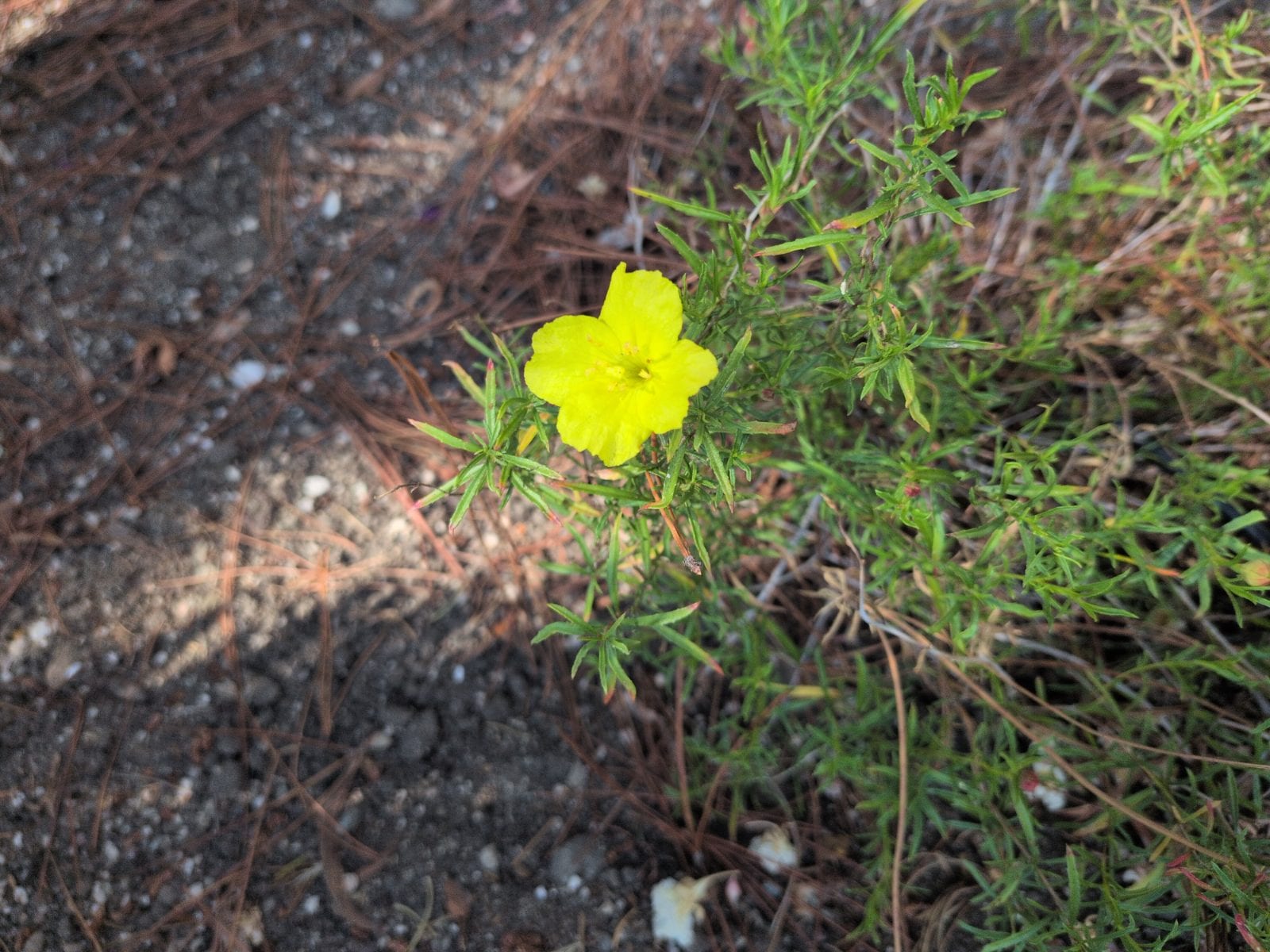
From the photo, the plant appears to be a young, bright yellow-flowered wildflower with narrow, lance-shaped leaves and slender, upright shoots—features that fit the genus Oenothera (evening primroses). The single, large, four-petaled yellow bloom resembles common evening primrose (Oenothera biennis), a biennial species often found in disturbed ground. However, several Oenothera relatives (and other yellow wildflowers) can look similar, so the identification is an informed guess. --- ## Plant characteristics (what you’re seeing) **Growth habit:** Common evening primrose is typically **biennial** in many climates. In the first year it forms a **rosette** of leaves close to the ground. In the second year it sends up one or more **erect, branching stems** that can reach roughly **60–150 cm (2–5 ft)** depending on conditions. **Leaves:** Leaves are generally **narrow and lanceolate** (leaf shapes like elongated ovals), often with a slightly rough or hairy texture. Along the stem they may become smaller toward the top. In your photo, the foliage looks thin and needle-like because the plant is still young and the leaves are relatively narrow. **Flowers:** The flowers are one of the most distinctive traits: - **Color:** bright to golden yellow. - **Petals:** **four petals**, broad but somewhat notched or rounded, forming a star-like bloom. - **Size:** often several centimeters across; young plants may show smaller flowers. - **Bloom timing:** evening primroses are famous for opening later in the day—flowers commonly open in the **late afternoon/evening** and may close by morning. **Fruiting/seed:** After flowering, it produces a **capsule** with many small seeds. The plant can self-seed readily, which is why it often appears in disturbed areas. --- ## Habitat and where it thrives Common evening primrose is a classic **pioneer** plant. It grows well in: - **Sandy or gravelly soils** - **Road edges, fields, lawns, construction sites, and disturbed ground** - **Full sun to partial sun** It tolerates dryness once established. In many regions it’s also considered a hardy “wild” ornamental because its blooms are showy and it attracts pollinators. --- ## Care guide (for home gardens or containers) If you want to keep this plant healthy in your garden, mimic its natural conditions: sunny, open soil, and good drainage. ### 1) Light - **Best:** **Full sun** (6–8+ hours). - **Partial shade:** can work, but plants may become less vigorous and flowers may be fewer. ### 2) Soil - **Type:** well-drained soil is key—loam, sandy loam, or even poorer soils. - **Drainage:** avoid heavy, waterlogged areas. Evening primrose doesn’t like “wet feet.” - **pH:** typically tolerates a wide range, from slightly acidic to neutral/alkaline. **Practical advice:** If planting in a garden bed, amend with compost sparingly and ensure drainage. If container-growing, use a potting mix plus extra grit/perlite to keep it airy. ### 3) Watering - **New plants:** water to help establishment—keep soil lightly moist but not soggy. - **Established plants:** water occasionally during prolonged dry spells. **Rule of thumb:** Let the top layer of soil dry between waterings. ### 4) Feeding / fertilizing Evening primrose generally does not need heavy fertilization. - If your soil is very poor, use a **light, balanced fertilizer** (or compost) once in spring. - Over-fertilizing (especially nitrogen) can lead to lush growth with fewer blooms. ### 5) Temperature and hardiness Common evening primrose tolerates a broad range of temperate conditions. - It behaves as a **biennial**, often overwintering in cooler climates. - In very warm regions, it may behave differently (sometimes shorter-lived). Protect young plants from extreme frost only if you have fragile seedlings; otherwise, it’s usually hardy. ### 6) Support and spacing Tall growth can occur in the second-year flowering season. - **Spacing:** give plants room (about 30–60 cm / 12–24 in depending on vigor). - **Staking:** only if wind or heavy rain causes lodging. ### 7) Pruning and deadheading - Deadheading (removing spent flowers) may reduce self-seeding and can prolong bloom. - If you want it to reseed and naturalize, leave some seed heads. For biennials, pruning before the second-year flowering season is usually not necessary. ### 8) Pest and disease notes Evening primroses are relatively tough but can face: - **Aphids** (especially on new growth) - **Slugs/snails** on young leaves - **Powdery mildew** in humid conditions (improved by sun and airflow) Integrated, low-impact responses work best: - Hand-remove pests or spray with water (for aphids) - Use physical barriers for slugs - Improve airflow and avoid overhead watering ### 9) Propagation Common evening primrose is typically grown from seed. - **Direct sow** after the danger of hard frost, or - Start indoors if you want earlier blooms. Seeds often germinate well with cool-to-mild temperatures. Because the plant is a pioneer, it may also appear through natural reseeding. --- ## Related information (why it’s interesting) ### Pollinators and ecology Evening primrose flowers are valuable to wildlife, especially **night or crepuscular pollinators**, depending on the region. Bright yellow blooms and nectar attract insects, including bees. ### Medicinal/ethnobotanical note Evening primrose species (especially **Oenothera biennis** and related) have a history of use for **evening primrose oil** derived from seeds (commonly sold as a supplement). Traditional uses vary by culture and preparation method, and supplements should be taken with appropriate caution. ### Naturalizing tendency Because it self-seeds, it can spread in gardens. If you want to keep it contained, deadhead before capsules mature. --- ## Safety and responsible handling If you plan to ingest or use plant products (like oils), make sure of the exact species and consult reliable sources or healthcare professionals. As with many wild plants, correct identification matters. --- ## Quick checklist for success - **Full sun** - **Well-drained soil** - **Water lightly the first weeks; then occasional watering** - **No heavy fertilizer** - **Deadhead if you don’t want self-seeding** If you can share your location (country/region) and whether you observed the flowers opening later in the day, I can refine the ID between Oenothera biennis and other similar evening primrose species.
Identification Time
August 22nd, 2026
Notice
The function of Plantypia is using AI, so it may be inaccurate. Please use it for fun and reference only.
A plant result page that leads to the next useful action
After checking the name, continue into official plant database results.